
Self-Assembled Monolayers (SAMs)
Self-assembled monolayers (SAMs) sit in a special regime: at ~2 nm thick, a single molecule layer, they are molecularly thin interfaces where even small changes in molecular order, contamination, or defect density can dominate real performance.
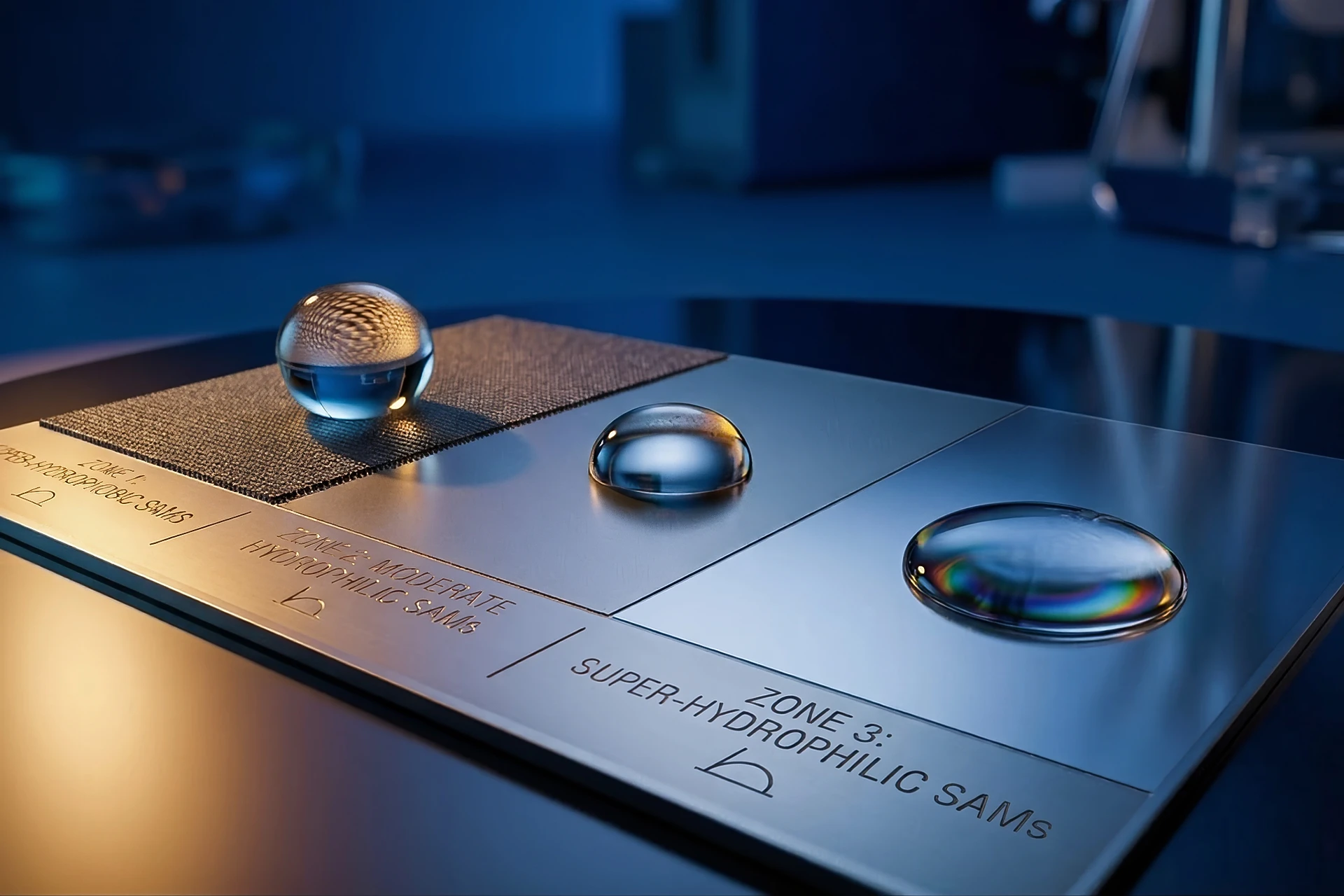
Early surface-energy and adsorption work set the stage for controlling wetting through organized molecular films, and organosulfur adsorption on gold became a cornerstone system for understanding why “one-molecule-thick” layers can still be robust when the surface and process are controlled. [1-3] A large body of later work established SAMs as a practical nanotechnology platform for engineering wetting, adhesion, corrosion initiation, bio-immobilization, and electronic properties. [4-5].
What is a SAM?
A SAM is an ordered molecular layer formed spontaneously when molecules adsorb on a surface and reorganize into a dense, typically one-molecule-thick film. [3–5] SAMs are not bulk additives and not “thin coatings” in the conventional sense, they are engineered first layers where chemistry and structure at the angstrom–nanometer scale dictate macroscopic outcomes.
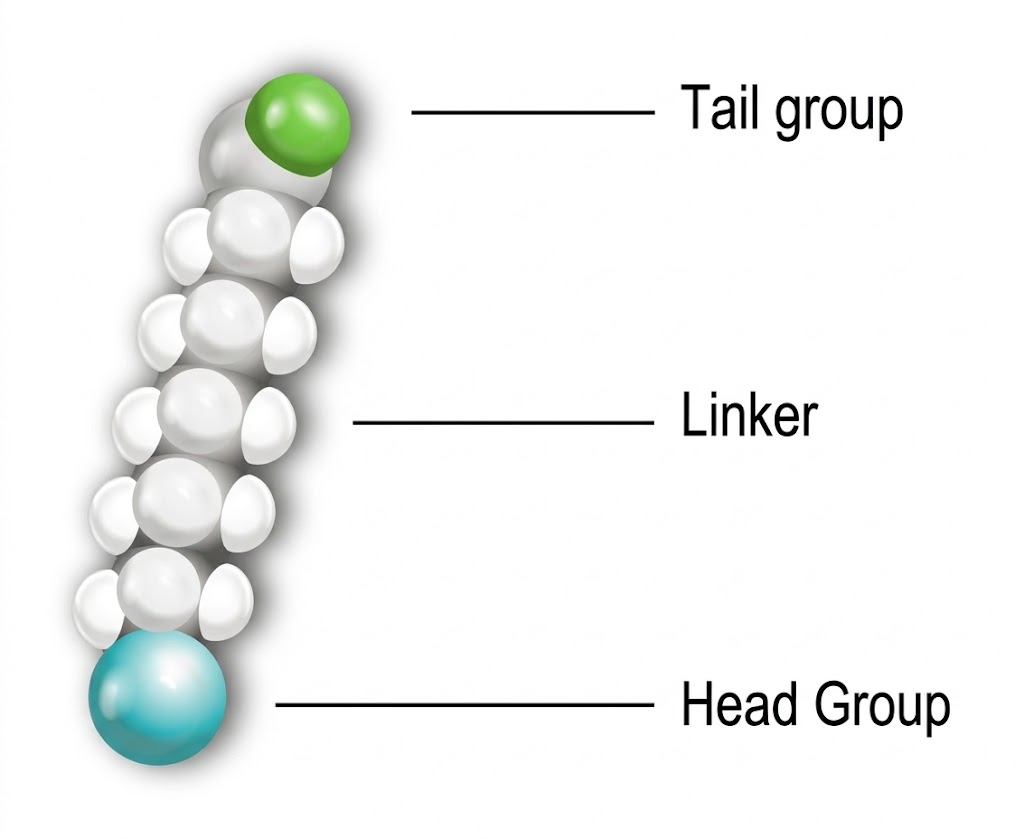
A typical SAM-forming molecule is usually described in terms of three parts (Figure 1):
- a head group, which binds to the surface,
- a linker (alkyl chain, ethylene-glycol-containing chain, etc.), which controls packing and thickness,
- and a tail or functional end group, which defines the interfacial properties. [4-6]
Core chemistries
Thiols / thiolates on noble metals
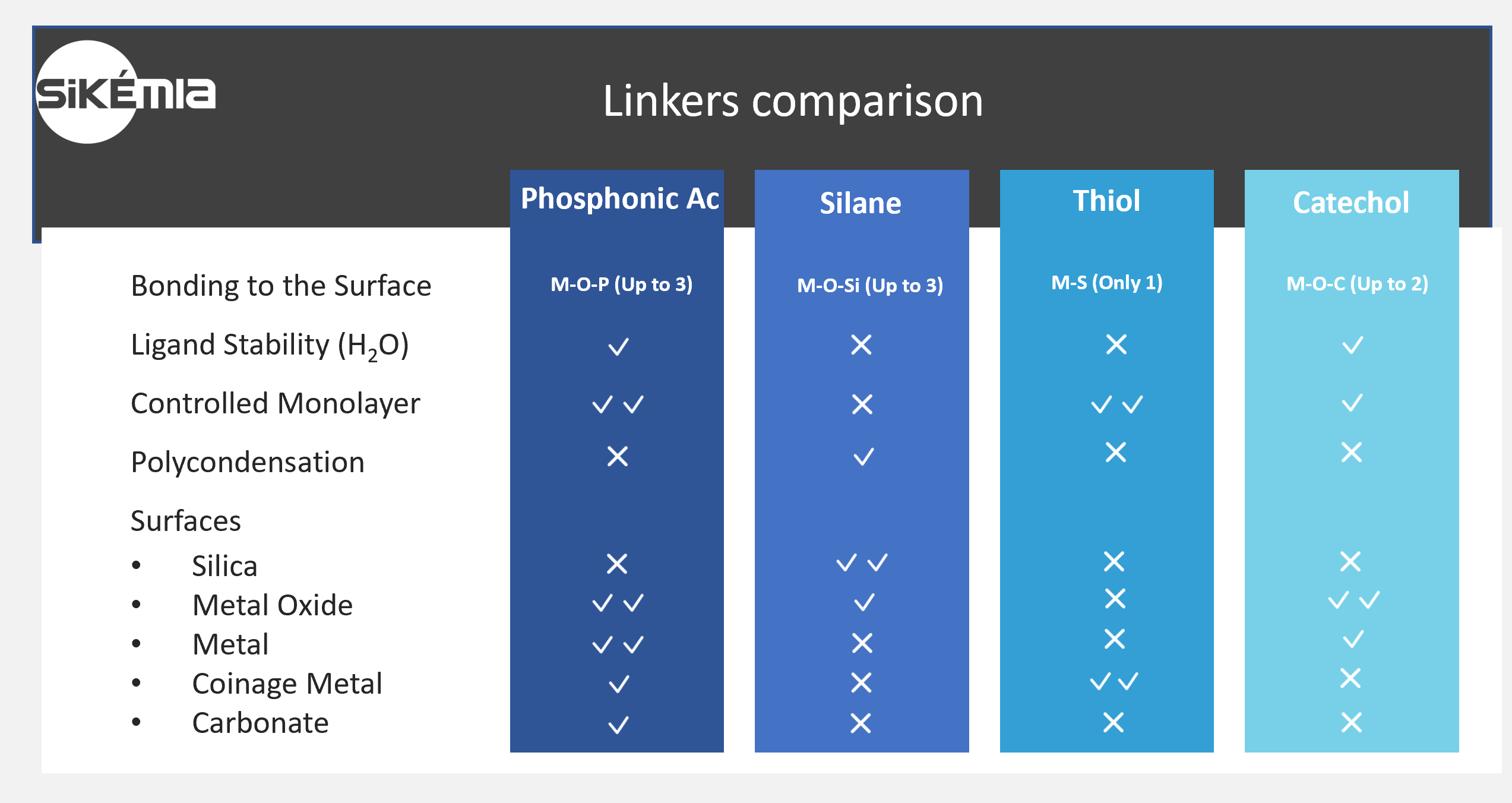
Gold–thiolate systems remain the reference point for SAM structure and functionalization strategies. [2,4,7-8] They are attractive for rapid assembly and broad end group chemistry, but stability is often environment dependent (oxidants, light, and handling can matter). [5,7]
Organosilanes on hydroxylated oxides
Silanes are widely used on SiO₂/glass and other oxides because they can form covalent siloxane networks and present diverse terminal functionalities. [9-11] Their biggest practical weakness is that they are highly sensitive to water content and surface hydroxylation: the same chemistry that enables covalent attachment also enables unwanted solution-phase polymerization and multilayers when the process window is not controlled. [10-12]
Phosphonic acids on metal oxides
Phosphonic acids/phosphonates are often chosen for oxides when strong binding and robustness are priorities; they commonly show strong affinity to many metal-oxide surfaces and can be useful in aqueous media and in integration-heavy workflows. [13-14]
Catechol-based anchors (oxide-like surfaces, wet environments)
Catechol-inspired anchoring chemistries (popularized by mussel-inspired approaches) are widely used for oxide-like surfaces and biomedical/wet contexts, where durable attachment in aqueous environments is useful. [18]
Comparative overview of SAM anchoring chemistries
This table compares common SAM head-group chemistries across substrates and key practical criteria (water stability, monolayer control, and process sensitivity).
How SAMs form
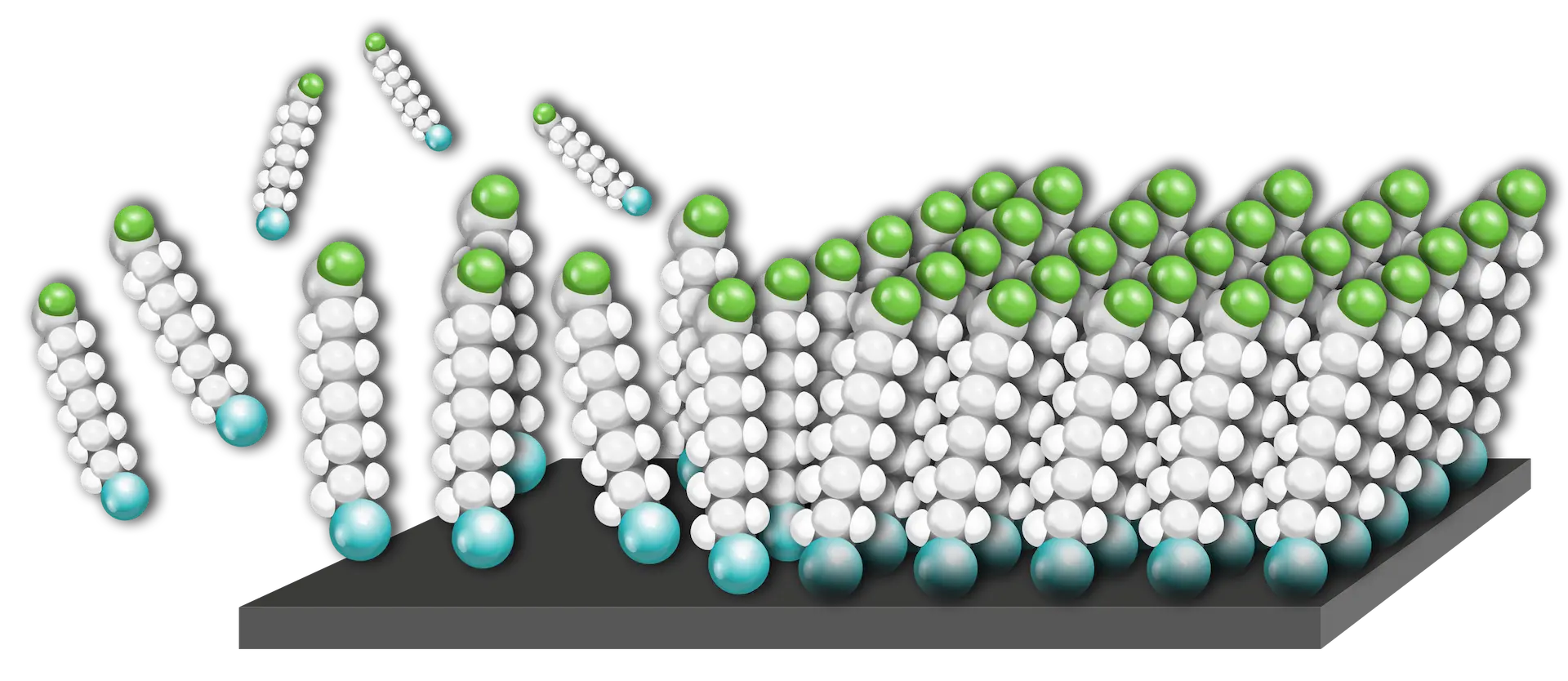
A practical process view is anchoring followed by ordering:
- Anchoring: molecules bind to the surface through the head group. This can be fast, and it can still occur on contaminated or suboptimal surfaces, so “something formed” is not proof of a good interface.
- Ordering: as coverage increases, molecules reorganize into domains; packing improves and defects evolve (Figure 2). This step is often slower and more sensitive to solvent quality, temperature, and molecular mobility. [5-6]
Chemistry selection: a decision checklist
There is no universal “best SAM”. A practical selection checklist is:
- Substrate: metal vs oxide; surface hydroxylation state; roughness/heterogeneity. [5,14]
- Exposure environment: humidity, oxidants, solvents, temperature cycling. [5-6]
- Process window: how tightly you can control water, cleanliness, and timing (especially for silanes). [10-12]
- Downstream integration: plasma/UV steps, solvents, adhesion stacks, electrical requirements, patterning. [14-15]
- Rework/removability: strong-binding systems can complicate reclaim. [13-14]
- Regulatory/sustainability constraints: fluorinated low-surface-energy treatments may be constrained under PFAS-related frameworks, pushing PFAS-free alternatives in some industrial contexts. [19-20]
Surface preparation
Surface preparation is usually the dominant factor for reproducibility, especially on oxides.
For silane chemistries, two variables repeatedly decide outcomes:
- Surface hydroxylation: the density and nature of -OH sites govern grafting probability and uniformity. [12]
- Timing and storage: oxide surfaces can change with ambient exposure (adsorbed water/organics), so “time from activation to deposition” becomes a process parameter. [10-12]
Reproducibility-focused silanization work emphasizes standardizing cleaning/activation steps and treating humidity/water as controlled inputs, not background conditions. [10–12]
Deposition: solution vs vapor
Solution deposition
Solution immersion is straightforward and scalable, but reproducibility depends on:
- solvent purity and water content,
- container cleanliness,
- concentration/time/temperature,
- rinse strategy (to remove physisorbed residues without stripping the bound layer). [10-11]
Silanes are particularly prone to “false positives”: contact angle can look right even when the surface is a mix of monolayer + oligomers/multilayers. [10-11]
Vapor deposition
Vapor-phase approaches are often chosen to reduce solution-phase polymerization (notably for silanes) and improve run-to-run reproducibility by shifting controls to chamber humidity, temperature, and partial pressure. Reviews oriented toward manufacturing readiness discuss vapor processing as a route to tighter uniformity and better integration into tool-based flows. [15]
Validation: measurements that correlate with performance
Because SAMs are only about ~2 nm thick, relying on a single quality-control indicator is risky.
A pragmatic validation stack is:
- Fast screen: contact angle (macroscopic indicator, not proof).
- Thickness/film-state check: ellipsometry when applicable (indicates the presence of multilayers).
- Chemical confirmation: XPS (bonding/elemental composition) and/or ToF-SIMS (fragments/mapping) depending on the failure mode.
- Use-case-relevant performance test: electrochemistry (defect sensitivity), adhesion test, corrosion exposure, or biofouling assay, whatever best predicts real performance. [5,15]
Stability and aging
Stability is chemistry- and environment-specific:
- Thiols on metals: can drift via oxidation and related chemistry changes under ambient exposure; stability should be validated under realistic light/oxidant handling conditions rather than assumed. [5]
- Silanes on oxides: can change through hydrolysis/condensation dynamics and contamination uptake; humidity control and storage matter. [10-12]
- Phosphonates on oxides: often favored when durability is a priority, but removability and process compatibility should be treated as design constraints early. [13-14]
A practical approach is to build a small aging matrix early (time × humidity × temperature × relevant chemical exposure) and treat storage/handling as part of the process. [5,10]
Scale-up and "industrial readiness" constraints
When SAMs move from lab demonstrations to engineered processes, attention shifts to:
- cleanliness and contamination control,
- uniformity across larger substrates,
- throughput and cost-of-ownership constraints,
- tool-to-tool variability. [15,22-23]
For workflows like area-selective deposition and integration-heavy semiconductor contexts, surface chemistry is treated as a process module with tight requirements on repeatability and compatibility with downstream steps, hence the emphasis on mechanistic understanding plus manufacturing metrics. [24-25]
Examples of applications
Biointerfaces / biosensing
SAMs enable controlled immobilization and can suppress nonspecific adsorption when designed as antifouling layers. OEG/PEG-terminated chemistries are widely used benchmarks, with extensive evidence for reduced nonspecific adsorption relative to many alternatives. [16-17]
Oxide anchoring in wet environments
Catechol-inspired chemistry is widely used as a robust “universal” anchor on oxide-like surfaces in wet conditions, particularly in biomedical surface modification contexts. [18]
Perovskite photovoltaics and interlayers
Phosphonic-acid SAMs have become prominent as ultrathin interlayers for tuning interfaces in perovskite device stacks, with reports of efficiency and stability benefits in relevant architectures. [21-22]
Area-selective deposition / integration-heavy workflows
Surface chemistries (including SAM-like inhibition layers) are central in area-selective deposition strategies; recent reviews discuss the surface-science and process-integration constraints that determine whether such layers are viable beyond the lab. [24-25]
Troubleshooting & Optimization
When performance is poor despite “good” contact angle:
- suspect multilayers/oligomers (common in silanes when water is uncontrolled), [10-11]
- suspect contamination (organics, residues) blocking ordering, [5,10]
- suspect defects/pinholes/domain boundaries dominating electrical/corrosion outcomes, [5-6]
- suspect aging/oxidation drift (common with thiols under ambient exposure). [5,26]
Corrective actions usually mean tightening the process window (humidity/water, activation timing), improving rinse/cleanup, and adding at least one chemical confirmation method (XPS/ToF-SIMS) plus a defect-sensitive performance proxy. [10-11,15]
Next steps with SAMs
Evaluate molecules
Browse 400+ bifunctional linkers across thiol, silane, phosphonate and specialty anchors: SiKÉMIA Products
Implement & qualify your process
Request protocol guidance for your substrate and application, and get support to diagnose performance issues and stabilize SAM process conditions: SiKÉMIA Services
Scale with confidence
Discuss qualification, regulatory compliance (PFAS-free options) and supply agreements.
Contact
References
[1] Bigelow, W. C.; Pickett, D. L.; Zisman, W. A. J. Colloid Sci. 1946, 1, 513–538. https://doi.org/10.1016/0095-8522(46)90059-1
[2] Nuzzo, R. G.; Allara, D. L. J. Am. Chem. Soc. 1983, 105, 4481–4483. https://doi.org/10.1021/ja00351a063
[3] Ulman, A. Chem. Rev. 1996, 96, 1533–1554. https://doi.org/10.1021/cr9502357
[4] Love, J. C.; Estroff, L. A.; Kriebel, J. K.; Nuzzo, R. G.; Whitesides, G. M. Chem. Rev. 2005, 105, 1103–1170. https://doi.org/10.1021/cr0300789
[5] Schreiber, F. Prog. Surf. Sci. 2000, 65, 151–257. https://doi.org/10.1016/S0079-6816(00)00024-1
[6] Schwartz, D. K. Annu. Rev. Phys. Chem. 2001, 52, 107–137. https://doi.org/10.1146/annurev.physchem.52.1.107
[7] Poirier, G. E. Chem. Rev. 1997, 97, 1117–1128. https://doi.org/10.1021/cr960074m
[8] Bain, C. D.; Troughton, E. B.; Tao, Y.-T.; et al. J. Am. Chem. Soc. 1989, 111, 321–335. https://doi.org/10.1021/ja00183a049
[9] Wasserman, S. R.; Tao, Y.-T.; Whitesides, G. M. Langmuir 1989, 5, 1074–1087. https://doi.org/10.1021/la00088a035
[10] Brzoska, J. B.; Azouz, I. B.; Rondelez, F. Langmuir 1994, 10, 4367–4373. https://doi.org/10.1021/la00023a072
[11] Fadeev, A. Y.; McCarthy, T. J. Langmuir 2000, 16, 7268–7274. https://doi.org/10.1021/la000471z
[12] McGovern, M. E.; Kallury, K. M. R. M.; Thompson, M. Langmuir 1994, 10, 3607–3614. https://doi.org/10.1021/la00022a038
[13] Gawalt, E. S.; Avaltroni, M. J.; Koch, N.; Schwartz, J. Langmuir 2001, 17, 5736–5738. https://doi.org/10.1021/la010649x
[14] Pujari, S. P.; Scheres, L.; Marcelis, A. T. M.; Zuilhof, H. Angew. Chem., Int. Ed. 2014, 53, 6322–6356. https://doi.org/10.1002/anie.201306709
[15] Onclin, S.; Ravoo, B. J.; Reinhoudt, D. N. Engineering Silicon Oxide Surfaces Using Self-Assembled Monolayers. Angew. Chem. Int. Ed. 2005, 44, 6282–6304. https://doi.org/10.1002/anie.200500633
[16] Prime, K. L.; Whitesides, G. M. Science 1991, 252, 1164–1167. https://doi.org/10.1126/science.252.5009.1164
[17] Hederos, M.; Konradsson, P.; Liedber, B. Langmuir 2005, 21, 2971–2980. https://doi.org/10.1021/la047203b
[18] Lee, H.; Dellatore, S. M.; Miller, W. M.; Messersmith, P. B. Science 2007, 318, 426–430. https://doi.org/10.1126/science.1147241
[19] European Chemicals Agency (ECHA). Annex XV Restriction Report – Per- and Polyfluoroalkyl Substances (PFASs); 2023.
[20] OECD. Reconciling Terminology of the Universe of Per- and Polyfluoroalkyl Substances: Recommendations and Practical Guidance; OECD Series on Risk Management No. 61; 2021.
[21] Wang, G.; Zheng, J.; Duan, W.; Yang, J.; et al. Joule 2023, 7(11), 2583–2594. https://doi.org/10.1016/j.joule.2023.09.007
[22] Aydin, E.; De Bastiani, M.; De Wolf, S. Adv. Mater. 2019, 31, 1900428. https://doi.org/10.1002/adma.201900428
[23] SEMI E35-0818. Guide to Cost of Ownership; SEMI: 2018.
[24] Bent, S. F. J. Phys. Chem. B 2002, 106, 11, 2830–2842. https://doi.org/10.1021/jp012995t
[25] Liu, T.-L.; Bent, S. F. Mater. Horiz. 2025, 12, 1711–1725. https://doi.org/10.1039/D4MH01472C
[26] Kankate, L.; Turchanin, A.; Gölzhäuser, A. Langmuir 2009, 25, 10435–10438. https://doi.org/10.1021/la902168u